
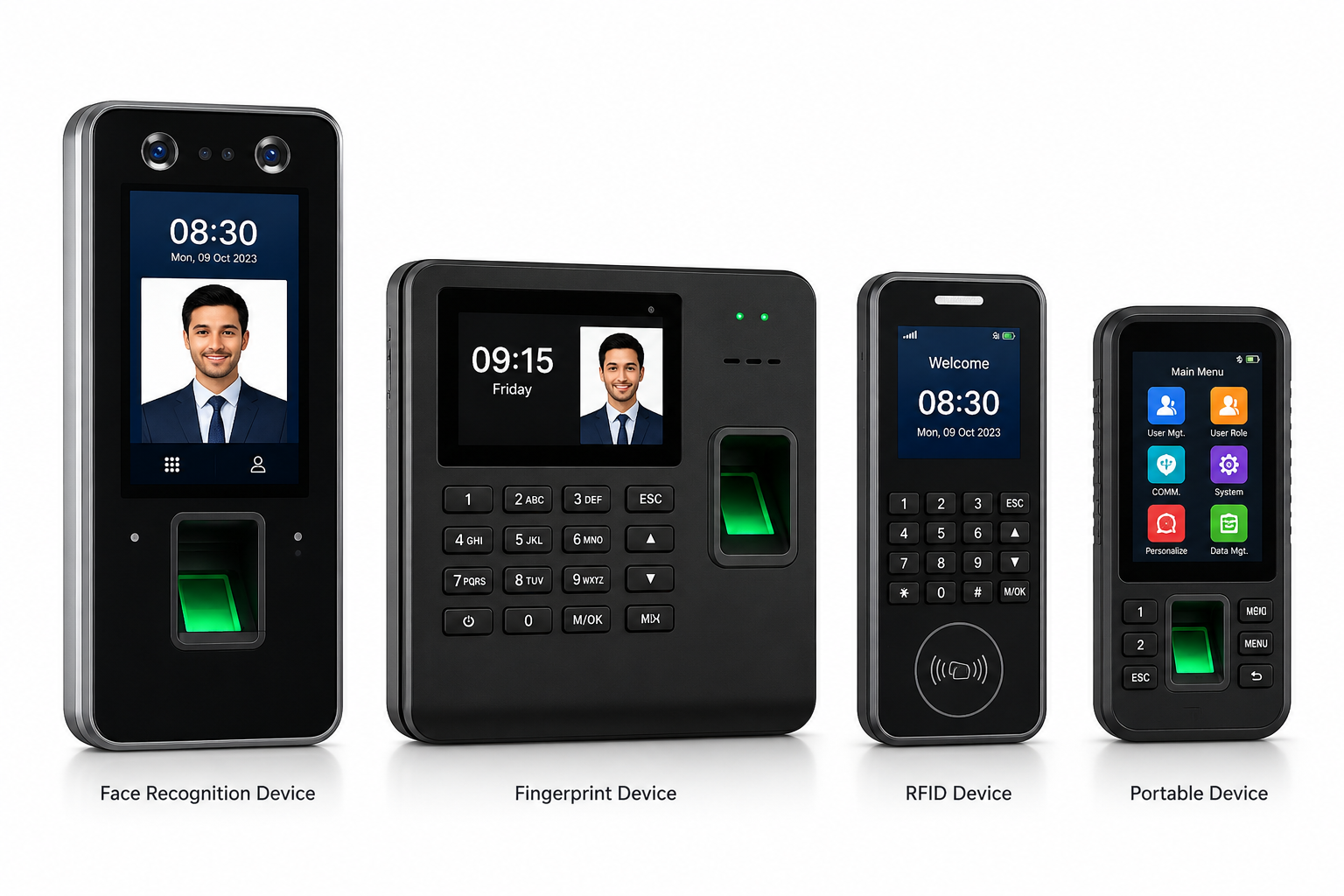
Biometric Attendance System vs Manual Attendance in Lucknow: Which Is Right for Your Business?
Every business in Lucknow eventually faces the same question: is it time to retire the paper attendance register? For decades, manual registers were the default simply because there was no practical alternative. Today that is no longer true. This guide sets out the real, practical differences in a biometric attendance system vs manual attendance comparison, so you can decide with confidence whether the time to upgrade has come.
You will find a side-by-side table, a worked cost example, honest answers to common objections and a simple plan for switching. Along the way, you will see how a biometric attendance system in Lucknow from Timeexa works with flat per-employee pricing. For the product itself, visit our biometric attendance machine software page.
Why This Comparison Matters for Lucknow Businesses
Lucknow’s business community runs from small family shops in Aminabad to large manufacturing units in Amausi and multi-branch offices in Gomti Nagar. Whatever the size, nearly every owner who still relies on manual attendance meets the same set of problems: inaccurate records, payroll disputes and hours lost each month reconciling handwritten entries. Seeing exactly how a biometric attendance system in Lucknow compares with traditional methods makes it easier to judge whether the switch is worth it for your own business.
Quick answer
A biometric system verifies who is present and records it instantly in the cloud, while a paper register records only what someone chose to write. For anything beyond a handful of employees, biometric attendance is usually more accurate, harder to cheat and cheaper over time.
Biometric Attendance System vs Manual Attendance: Side-by-Side Comparison
This table sets a biometric attendance system vs manual attendance register against the points that matter most to owners and HR teams:
| Point of comparison | Manual register | Biometric attendance system |
|---|---|---|
| Identity check | None; anyone can write any name. | Face, fingerprint or card confirms the person. |
| Accuracy of time | Written from memory, often rounded. | Timestamped automatically at the moment of entry. |
| Buddy punching | Easy to do and hard to prove. | Very difficult, since the person must be present. |
| Month-end work | Hours of copying into spreadsheets. | Data flows straight to payroll. |
| Visibility | Only after registers are collected. | Live on a cloud dashboard from any location. |
| Multiple branches | Separate registers and separate totals. | One dashboard across every site. |
| Loss or damage | A lost register means lost records. | Cloud storage with backup. |
| Disputes | Hard to settle without evidence. | Timestamped records settle most arguments. |
| Overtime and shifts | Calculated by hand, prone to error. | Calculated from recorded punches. |
| Upfront cost | Near zero. | Device and software, priced per employee. |
The Real Manual Attendance Register Problems Lucknow Businesses Report
Before comparing the two systems directly, it is worth being honest about what manual attendance involves day to day. These are the most common manual attendance register problems reported by businesses in Lucknow:
Illegible or incomplete entries
Smudged ink, unclear handwriting and missing lines are common, especially in the morning rush when everyone is hurrying to start work.
No real verification
A register proves only that someone wrote a name and a time. It does not prove that the person who wrote it was the person who worked.
Time-consuming reconciliation
At month-end, HR often spends hours copying register data into spreadsheets before payroll can even begin.
No real-time visibility
Owners with several locations across Lucknow cannot check attendance remotely and must wait for registers to be collected.
Loss or damage
A misplaced or damaged register can wipe out a month of attendance with no backup.
Want to see the difference on your own premises? Get a free demo.
Get Free Demo on WhatsApp →A Day in the Life: Paper Register vs Biometric Attendance
The difference becomes clearer when you follow an ordinary working day through both systems.
| Moment | With a paper register | With biometric attendance |
|---|---|---|
| Morning arrival | Staff queue to sign, and early arrivals write times they remember or guess. | A quick scan logs the exact arrival time, with no queue at a notebook. |
| Shift change | Two shifts share one register, and entries overlap or go missing. | Each punch is matched to the right shift automatically. |
| Someone is absent | A colleague may sign for them, and nobody notices. | No verified punch means no attendance. |
| Midday query | “Who is in today?” needs a call to the supervisor. | The dashboard shows present, absent and late staff live. |
| Month-end | Days spent counting, copying and arguing about entries. | Attendance is already summarised and feeds payroll directly. |
Buddy Punching Prevention: Why Biometrics Win
One of the biggest problems with manual and even basic card-based systems is buddy punching, where one employee marks attendance for a colleague who is not there. Buddy punching prevention is among the strongest arguments for biometric verification, because a face or fingerprint cannot be shared or borrowed the way a signature or swipe card can.
For larger teams in manufacturing, retail and logistics, buddy punching can quietly inflate payroll by paying for hours that were never worked. Over a year, that becomes a meaningful and entirely avoidable cost. It takes several common forms:
- Signing in for an absent friend on a paper register.
- Lending a swipe card to someone running late.
- Padding the time by writing an earlier arrival or a later departure.
- Covering for a whole group when supervisors are not watching.
Strong buddy punching prevention removes all of these at the point of entry, rather than trying to catch them afterwards.
Three Mini Comparisons: Factory, Shop and Office
The biometric attendance system vs manual attendance question looks different depending on the workplace. Here is how it plays out in three typical Lucknow settings:
- A factory in Amausi or Chinhat. A paper register at the gate cannot keep up with a shift change. Names are skipped, times are guessed and overtime is argued about. Attendance software for factories in Lucknow records every punch against the right shift and gives supervisors a live view of who is on the floor.
- A shop or showroom in Aminabad or Hazratganj. Staggered shifts and festival hiring make a notebook messy. A biometric attendance system in Lucknow records arrival at each outlet, and the owner sees every shop on one screen instead of visiting each one.
- An office in Gomti Nagar. Hybrid days and flexible hours are hard to capture on paper. Face recognition at the door and mobile check-ins for remote days give one consistent record per person.
Fairness and Trust: What Employees Gain From Biometric Attendance
Owners often assume biometric attendance is something done to employees. In practice, honest employees usually benefit as much as the business does, because the record protects them as well.
- Proof of presence. A conscientious worker who arrived on time has a timestamped record to show if someone questions it.
- Fewer unfair deductions. When late marks and absences come from data rather than a supervisor’s memory, mistakes are rarer.
- Equal treatment. The same rule applies to everyone, so favouritism is harder.
- Clear overtime. Extra hours worked are recorded and paid, rather than forgotten.
- No unfair blame. Under manual attendance register problems such as a lost page, nobody can prove what really happened.
Explain this when you introduce the system. Presented as a fairness measure rather than a surveillance tool, it earns far more cooperation.
How a Biometric Attendance System in Lucknow Solves These Problems
A modern biometric attendance system in Lucknow answers each of those problems directly:
- Verified identity — face recognition, fingerprint or RFID confirms that the person marking attendance is who they say they are.
- Instant, accurate records — every check-in and check-out is logged automatically and precisely.
- Real-time cloud access — with cloud attendance software, owners and HR can view attendance from anywhere.
- Automated payroll integration — verified attendance flows into payroll with no monthly reconciliation.
- Security and backup — cloud-stored records are protected from the loss or damage that can wipe out a paper register.
Employee Attendance Accuracy: A Direct Comparison
On employee attendance accuracy, the difference between the two systems is not subtle. Manual attendance depends entirely on human diligence: employees remembering to sign in and out correctly, and administrators transcribing the data correctly afterwards. A biometric system removes that dependence, capturing precise, timestamped and verified records the moment someone checks in.
For industries with strict shift patterns, such as factories in Amausi, Chinhat and Sarojini Nagar, accuracy matters even more. Attendance software for factories in Lucknow has to track attendance against rotational shifts, night shifts and overtime with precision, something manual registers cannot do reliably at scale. Read more about payroll software in Lucknow to see how that accuracy carries through to salary.
Owners With Several Locations: Seeing Everything at Once
For a business with a head office, a shop and a workshop, the difference between the two systems is dramatic. With manual attendance, each site keeps its own register, someone collects them, and you see the picture days late and incomplete. With cloud-based biometric attendance:
- Every location reports into one dashboard in real time.
- You can compare lateness and absence between sites without phoning anyone.
- Branch managers see only their own team, while head office sees everything.
- One payroll run covers every location, from verified records.
Biometric Attendance System vs Manual Attendance Costs: A Worked Example
Cost is where the biometric attendance system vs manual attendance debate is most often misunderstood. It is a common misconception that manual attendance is free because it needs no hardware or software. In reality it carries hidden costs that appear in other parts of the business. Here is an illustration for a 40-person Lucknow business with an average monthly wage of ₹15,000, giving a ₹6 lakh payroll:
| Hidden cost | Assumption | Monthly cost |
|---|---|---|
| Admin time reconciling the register | 12 hours at ₹150 an hour | ₹1,800 |
| Proxy attendance and time padding | 1% of payroll | ₹6,000 |
| Payroll errors and disputes | 1% of payroll | ₹6,000 |
| Total hidden cost | ₹13,800 |
Set against the software cost
These are illustrative assumptions, not a guarantee. Your own wages, error rates and admin time will differ, so replace the figures with your own to see the real comparison.
Biometric Attendance Machine Benefits Beyond Accuracy
A full analysis of biometric attendance machine benefits usually shows that businesses recover their investment within a few months through fewer payroll disputes and less administrative overhead. The gains go further than accuracy:
- Fewer arguments, because timestamped records are hard to dispute.
- Faster payroll, because attendance is already summarised.
- Better planning, because live data shows absence and lateness patterns.
- Stronger discipline, because everyone is held to the same record.
- Audit readiness, because records are searchable and hard to alter.
- Scalability, because adding a branch or a hundred employees adds no paperwork.
Ready to retire the register? Talk to us on WhatsApp.
Get Free Demo on WhatsApp →Our Products: Complete Workforce Management Solutions
Timeexa offers a complete biometric attendance software solution built to help Lucknow businesses move smoothly away from manual tracking. It supports face recognition, fingerprint and RFID, and it connects to five other products on the same platform. Explore everything on the Timeexa home page, or open any product below.
Biometric Attendance System
Verifies each person by face, fingerprint, RFID card or QR code, and pushes every punch to the cloud in real time.
- Face Recognition Attendance
- Fingerprint Attendance
- RFID Card Support
- QR Code Attendance
- Real-Time Cloud Sync
Cloud Attendance Software
Runs attendance, shifts, leave and holidays from a secure dashboard you can open from any device.
- Multi-Company Management
- Multi-Branch Support
- Employee Self Service
- Attendance Dashboard
- Leave Management
Payroll Management Software
Turns verified attendance into salary, overtime and payslips, without anyone retyping hours.
- Salary Automation
- Overtime Calculation
- PF & ESI Support
- Payslip Generation
- Payroll Reports
GPS Workforce Tracking
Keeps field staff, technicians and drivers accountable with location-based attendance and visit records.
- Live Location Tracking
- Geo-Fencing
- Route Monitoring
- Visit Tracking
- Mobile Attendance
Mobile Attendance App
Lets employees mark attendance from their own phones, with a selfie and location as proof.
- Selfie Attendance
- Geo Attendance
- Mobile Attendance
- Leave Requests
- Attendance History
Visitor Management System
Replaces the gate register with OTP-verified visitor check-ins, photo capture and digital passes.
- Visitor Registration
- OTP Verification
- Visitor Pass Printing
- Employee Approval Workflow
- Reception Dashboard
Biometric Attendance System vs Manual Attendance: Common Objections, Answered Honestly
Most owners weighing a biometric attendance system in Lucknow have a specific worry. These are the ones we hear most often, with straight answers:
| Objection | The reality | What to do |
|---|---|---|
| “It is too expensive.” | Manual attendance has hidden costs in errors, disputes and admin time. | Compare total cost, using a flat per-employee rate. |
| “My staff will resist it.” | Resistance usually fades when rules are explained and the device is quick. | Brief staff first, enrol in batches and run a pilot. |
| “My workers are not tech-savvy.” | Looking at a device or touching a sensor needs no technical skill. | Have a helper at the device during the first week. |
| “What about power cuts?” | Any electronic system needs power planning. | Plan a backup, and ask the vendor how data catches up after an interruption. |
| “Is biometric data safe?” | It is personal data and deserves care. | Ask about encryption, access control and deletion, and tell staff what is collected. |
| “We only have a few staff.” | Small teams still lose time and trust to disputes. | Per-employee pricing means you pay only for the team you have. |
Reports You Simply Cannot Get From a Paper Register
A register can tell you who signed. A digital system can tell you much more, and that is where employee attendance accuracy turns into better decisions:
- Live present, absent and late counts for every location, updated as people arrive.
- Absenteeism trends by team or day of the week, showing where problems are building.
- Overtime summaries by shift, so extra hours are visible and controlled.
- Late-arrival patterns for individuals and teams, with the exact times.
- Leave balances and history for each employee.
- Pre-payroll summaries that make month-end a short review instead of a project.
When a Paper Register Is Still Fine
An honest biometric attendance system vs manual attendance comparison should also say when manual attendance is enough. If you run a very small team of a few people, everyone is present in one place under your direct supervision, and there are no shifts, no overtime and no payroll complexity, a simple register can work. Even then, the case for switching strengthens as soon as you add a second location, a shift pattern, field staff or your first dispute over hours.
The safest approach is to treat the register as a starting point rather than a permanent choice, and to move to software before the problems build up rather than after.
A Quick Self-Check: Is Your Register Costing You Money?
Answer these honestly. Every “yes” is a sign that manual attendance register problems are already costing you something:
- Do you spend more than a few hours each month turning register entries into salary figures?
- Has an employee disputed a late mark or an absence in the last three months?
- Do you suspect, even occasionally, that someone signed for a colleague?
- Would you struggle to say how many people were present at a branch yesterday?
- Have you ever lost, damaged or been unable to find part of a register?
- Do overtime hours get claimed without a reliable record?
Two or more “yes” answers suggest that a biometric attendance system would pay for itself quickly in your business.
Moving From the Paper Register to Biometric Attendance: A Two-Week Plan
- Days 1 to 3: PrepareList employees, shifts and leave rules, choose the method for each entrance and decide where devices will go.
- Days 4 to 7: Install and enrolSet up the device, enrol staff in small batches and have a helper on hand to answer questions.
- Days 8 to 12: Run both side by sideKeep filling the register while the new system records the same days, and compare totals each evening.
- Days 13 to 14: Switch overWhen the numbers match, retire the register and let payroll draw from the digital record.
Industries We Serve: Solutions for Every Industry
Timeexa provides attendance and workforce management for a wide range of sectors, from corporate offices to construction sites.
- Corporate Offices
- Manufacturing Units
- Schools & Colleges
- Hospitals & Healthcare
- Government Organizations
- Construction Companies
- Logistics & Transport
When Should a Business Make the Switch?
If your Lucknow business is experiencing any of the following, it is likely time to move away from manual attendance:
- Frequent payroll disputes about unclear or contested working hours.
- Difficulty tracking attendance across several branches or locations.
- A growing team that makes manual reconciliation increasingly slow.
- Suspected or confirmed buddy punching.
- A need for real-time visibility into who is present, absent or late.
Businesses in nearby Uttar Pradesh cities can run the same platform in Kanpur, Varanasi, Gorakhpur, Agra and Noida. See every sector on our industries page.
Beyond Attendance: Payroll, Field Staff and Visitors
Beyond capturing attendance, Timeexa connects directly with payroll management software, so verified working hours feed into salary calculations and remove the reconciliation that eats HR time under a paper system. For field staff, the mobile attendance app with GPS workforce tracking extends verification beyond the office, and the visitor management system brings the same digital discipline to the front desk. For the wider HR picture, see our page on HRMS software in Lucknow.
Records, Privacy and Compliance: Paper vs Digital
Employers must keep proper attendance, hours, overtime and leave records under the labour laws that apply to them. Digital records can be easier to search, back up and produce on request, but check with a qualified professional that your digital records meet the requirements that apply to your business. Whether PF and ESI apply depends on headcount and wage levels, which change from time to time, so see the Employees’ Provident Fund Organisation and the Employees’ State Insurance Corporation. Biometric data is personal data, and India’s Digital Personal Data Protection Act, 2023 governs how it is handled, with updates at meity.gov.in. Tell employees in writing what is collected and why.
What Teams of Different Sizes Pay
Pricing is a flat ₹10 per employee per month, so your cost is simply headcount multiplied by ten:
| Team size | Per month | Per year | Typical Lucknow business |
|---|---|---|---|
| 10 employees | ₹100 | ₹1,200 | Small shop or clinic |
| 40 employees | ₹400 | ₹4,800 | Showroom or growing office |
| 100 employees | ₹1,000 | ₹12,000 | Workshop or multi-outlet retailer |
| 300 employees | ₹3,000 | ₹36,000 | Manufacturing unit or large campus |
The biometric attendance system vs manual attendance question comes down to accuracy, accountability and time saved. Registers may look simpler, but the hidden costs of disputes, buddy punching and admin overhead usually outweigh any perceived saving.
Timeexa’s Biometric Attendance System Pricing — Just ₹10/Employee/Month
In the biometric attendance system vs manual attendance decision, price matters, so Timeexa keeps it simple. For Lucknow businesses ready to leave the register behind, it combines biometric verification, payroll integration and a flat per-employee rate. Attendance, payroll, leave, shifts, GPS tracking and visitor management sit on one platform. Learn more on the Timeexa website.
- Pay only for the employees you track
- No hidden charges
- No long-term lock-in contracts
- Face, fingerprint, RFID and QR code attendance supported
- Attendance, leave, shift and payroll on one platform
For example, a 40-person business pays ₹400 a month and a 100-person business pays ₹1,000 a month. See the full details on our pricing page.
Frequently Asked Questions
Q: Is biometric attendance really more accurate than manual registers?
Yes. Biometric verification captures precise, timestamped, and identity-verified records automatically, removing the human error and manipulation risks inherent in handwritten registers.
Q: How does biometric attendance prevent buddy punching?
Since biometric verification relies on unique physical characteristics like fingerprints or facial features, one employee cannot mark attendance on behalf of another, unlike a signature or shared access card.
Q: Is switching from manual to biometric attendance expensive?
Not with Timeexa. The first year is completely free, and renewal from year two is a flat ₹999 per year, making the switch accessible even for small businesses with limited budgets.
Q: Can biometric attendance data be used directly for payroll?
Yes. When properly integrated, verified attendance data flows automatically into payroll calculations, removing the need for manual cross-checking between attendance and salary records.
Q:How long does it take to switch from manual to biometric attendance?
Most businesses can be fully set up within a single day, including device installation and employee enrollment, after which attendance data begins syncing to the cloud dashboard immediately.