Attendance registers, sign-in sheets, and shared login IDs all have one problem in common — they rely on trust, not proof. An employee can sign in for a colleague, forget to log out, or dispute their recorded hours at month-end. Biometric attendance software removes that ambiguity entirely by tying attendance to something that can’t be shared or faked: a fingerprint or a face.
In this guide, we’ll explain what biometric attendance software actually is, how it works, why it’s become the standard for offices, factories, and multi-branch businesses, and how it connects directly into payroll to save your HR team hours every month.
What is Biometric Attendance Software?
Biometric attendance software is a system that records employee check-ins and check-outs using unique physical identifiers — most commonly a fingerprint scan or facial recognition — instead of manual entry, ID cards, or shared logins. Because a fingerprint or face can’t be transferred to another person, it eliminates one of the most common attendance problems: buddy-punching, where one employee marks attendance on behalf of another.
A modern biometric attendance system typically includes two connected parts:
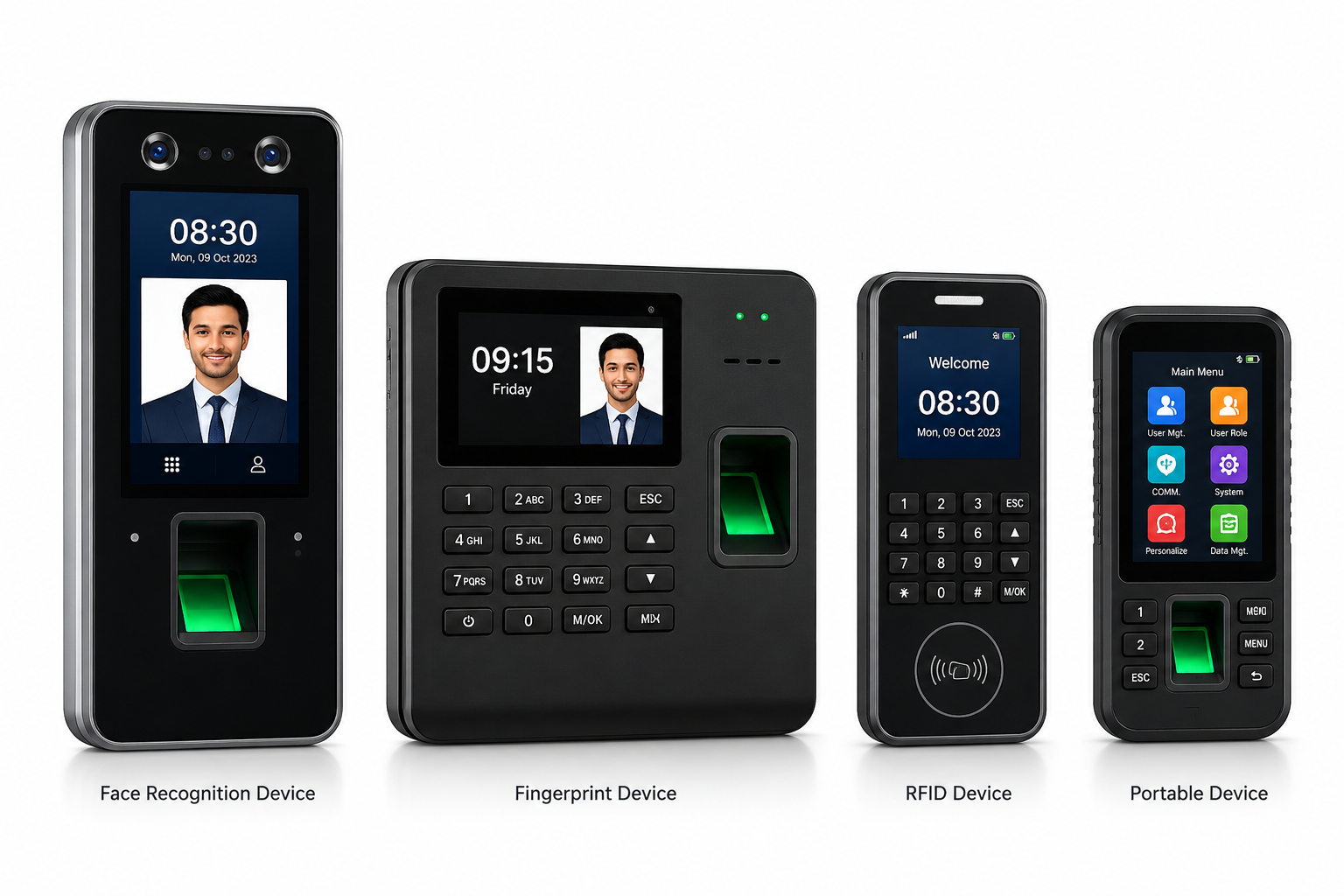
- The biometric device or machine — a fingerprint scanner or facial-recognition camera installed at the entry point, which captures the biometric data at the moment of check-in.
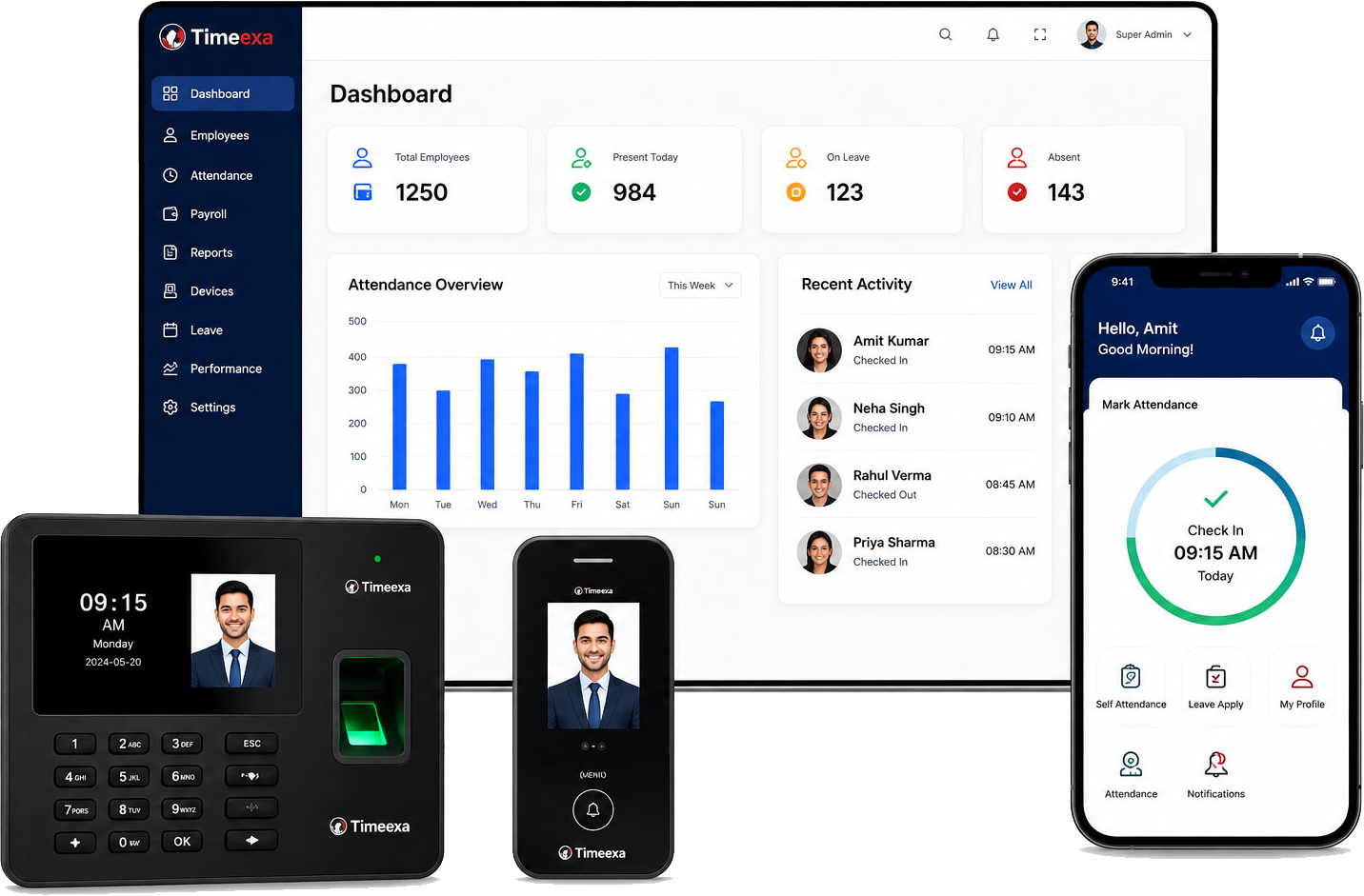
- The software layer — which processes that data, applies attendance rules (late marks, shifts, holidays), and makes the records available on a live dashboard for HR and management.
Together, these two components are what separate a simple biometric attendance machine from a complete attendance management solution — the hardware alone only captures data; the software turns that data into usable, policy-compliant attendance records.
Why Buddy-Punching and Manual Attendance Are Bigger Problems Than They Seem
It’s easy to underestimate how much manual or card-based attendance actually costs a business. Here’s what typically happens without biometric verification:
- Buddy-punching inflates payroll. Studies across industries consistently show that time theft through proxy attendance can silently add several percentage points to labor costs every month.
- Disputes over hours worked. Without a verifiable record, disagreements between employees and HR over late marks or absences become common — and hard to resolve fairly.
- ID cards get lost, shared, or forgotten. Card-based systems solve the paperwork problem but not the identity problem — a card can still be handed to someone else.
- Manual registers are error-prone. Handwritten or spreadsheet-based attendance is time-consuming to compile and easy to falsify.
- No real-time visibility. Management often only discovers attendance issues — like a spike in late arrivals — well after they’ve already affected productivity.
Face recognition attendance and fingerprint-based systems solve all of these at the source, by making the attendance record itself tamper-proof.
How Biometric Attendance Software Actually Works
The process is straightforward, but the technology behind it is what makes it reliable:
Step 1 — Enrollment. Each employee’s fingerprint or facial data is captured once during onboarding and securely stored as an encrypted template — not a raw image — inside the system.
Step 2 — Check-in/Check-out. When an employee scans their finger or faces the camera, the device matches it against the stored template in real time, confirming identity in under a second.
Step 3 — Rule Application. The software automatically applies your attendance policy — grace periods, late-mark rules, shift timing, and holiday calendars — without any manual calculation.
Step 4 — Sync and Reporting. Attendance records update instantly on a central, cloud-connected dashboard, giving HR and management live visibility across every device and location.
Step 5 — Payroll Integration. The same verified attendance data flows directly into salary calculation, so payroll is based on accurate, tamper-proof records rather than manually compiled sheets.
This end-to-end flow is what makes biometric attendance software far more valuable than the biometric machine alone — the hardware captures accurate data, but the software is what turns it into operational and payroll accuracy.
Fingerprint vs. Face Recognition — Which Should You Choose?
Both methods solve the same core problem — verifying identity without room for proxy attendance — but they suit different environments:
- Fingerprint-based biometric attendance machines are highly accurate and cost-effective, and work well in controlled indoor environments like offices and retail stores. They can be slightly less reliable for employees with worn or damaged fingerprints, such as factory or manual labor staff.
- Face recognition attendance systems are contactless, faster for high-traffic entry points, and don’t degrade with physical wear. They’ve also become more relevant post-pandemic, since employees don’t need to physically touch a shared device.
Many growing businesses now deploy both — fingerprint devices at low-traffic entry points and face recognition at high-traffic ones — all connected to the same central attendance dashboard.
Key Features to Look For in Biometric Attendance Software
Not every biometric system on the market is built for real operational use. When evaluating one, prioritize:
- High-accuracy matching — low false-rejection and false-acceptance rates, especially important for larger teams.
- Cloud connectivity — attendance data should sync in real time to a central dashboard, not require manual export from each device.
- Multi-device support — the ability to connect multiple biometric machines across branches under one unified system.
- Shift and leave rule automation — attendance policies applied automatically, without manual adjustment each month.
- Payroll-ready data export — attendance records that flow directly into salary processing without re-entry.
- Offline resilience — devices that continue capturing attendance during internet outages and sync automatically once reconnected.
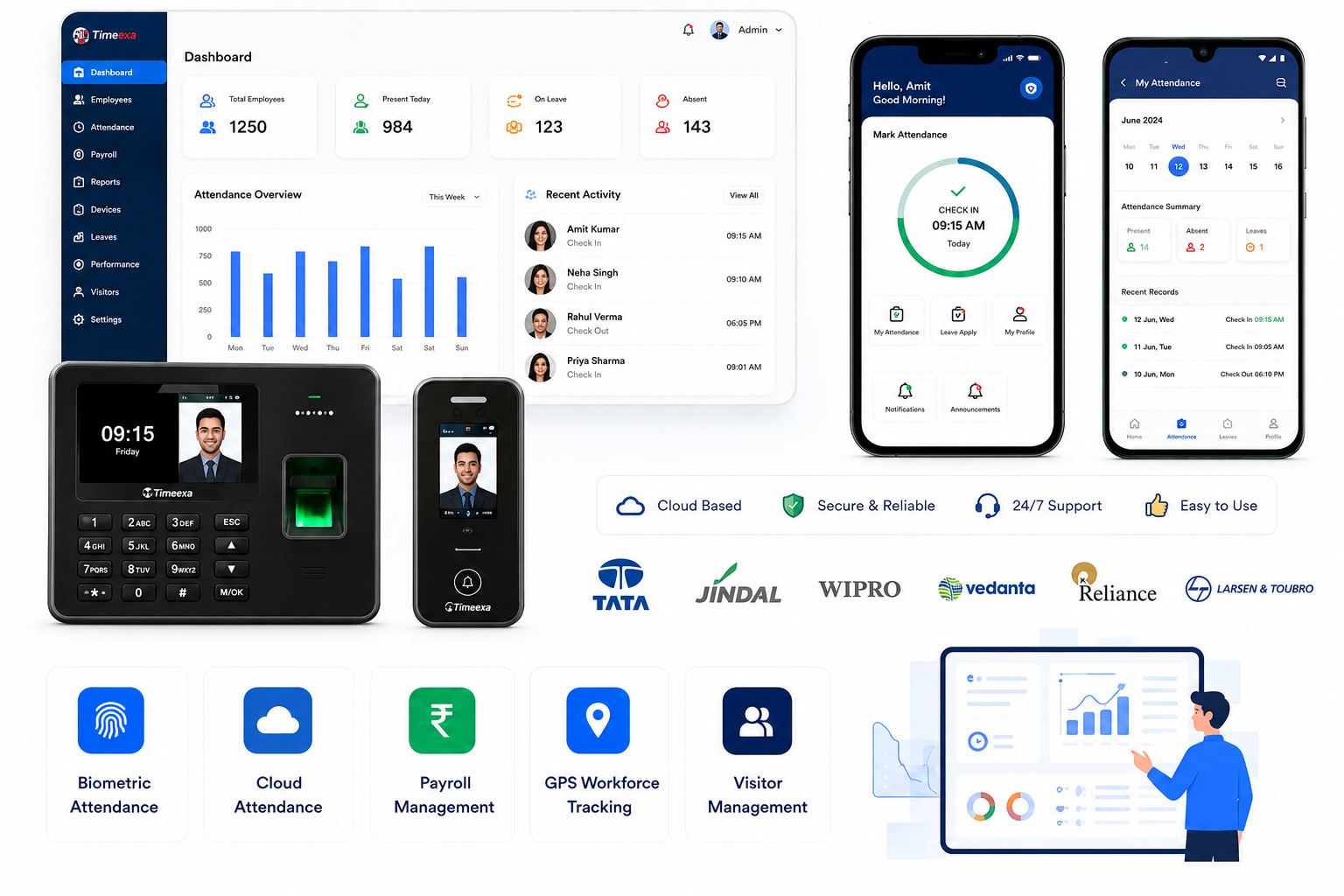
A platform that combines reliable hardware with this kind of software layer is what actually delivers ROI — not just accurate check-ins, but accurate payroll and reporting downstream. This is the approach behind Timeexa’s biometric attendance system, built to work as part of a connected attendance and payroll ecosystem rather than a standalone device.
Biometric Attendance as Part of a Bigger System
Biometric devices work best when they’re not operating in isolation. Depending on how your workforce is structured, you may need to combine biometric attendance with other tracking methods:
- For businesses with multiple branches, a cloud attendance software setup gives one dashboard view across every biometric device, no matter the location.
- For field, sales, or delivery staff who aren’t near a fixed device, GPS workforce tracking extends attendance capture to wherever employees actually work.
- For hybrid teams or employees who need flexibility, a mobile attendance app lets staff check in via selfie or GPS when a biometric device isn’t available.
- For payroll teams tired of manual reconciliation, a connected payroll management software turns verified biometric attendance directly into accurate salary calculations.
- For organizations that also manage guests or contractors on-site, a visitor management system adds that layer alongside employee attendance tracking.
The real value comes from having biometric data, mobile check-ins, and payroll all flow into the same system — rather than running separate tools that need manual reconciliation between them.
Pricing — What Should You Expect to Pay?
Biometric attendance software pricing typically depends on the number of employees, how many devices or branches you need to connect, and whether you want cloud hosting bundled in with hardware support.
Timeexa offers four transparent plans built around this:
- Starter Plan — Free (first year): Built for small offices, clinics, retail shops, and startups with up to 50 employees. Includes unlimited biometric devices, employee and attendance management, a live attendance dashboard, basic reports, and cloud hosting. Renewal is ₹999/year from the second year, complimentary in year one with a supported biometric device purchase.
- Business Plan — ₹499/month: For SMEs, schools, hospitals, and manufacturing units with up to 250 employees. Adds leave, holiday, and shift management, duty roster planning, device monitoring dashboard, and advanced attendance reports.
- Professional Plan — ₹999/month: For multi-location organizations and growing enterprises with up to 1,000 employees. Adds face enrollment management, RFID/card enrollment, bulk enrollment upload, device health dashboard, and branch-wise analytics.
- Enterprise Plan — ₹2,499/month: For large enterprises and factories with up to 5,000 employees. Adds API access, webhook and ERP/HRMS integration, single sign-on (SSO), custom reports, and a dedicated account manager with SLA-based support.
Since every plan — including the free Starter tier — includes unlimited biometric devices, businesses of almost any size can deploy biometric attendance without worrying about per-device licensing costs. Full details and the latest rates are on Timeexa’s pricing page, and a free demo is available to test the system before choosing a plan.
Rolling Out Biometric Attendance: What to Expect
Deploying biometric attendance across a team usually takes far less time than businesses expect:
- Device installation — biometric machines are installed at entry points and connected to the network.
- Employee enrollment — fingerprint or facial data is captured for each employee, either individually or via bulk enrollment.
- Policy configuration — shift timings, grace periods, and leave rules are set up in the software.
- Parallel run — the biometric system runs alongside any existing attendance method for one cycle to validate accuracy.
- Full rollout — once validated, biometric check-in becomes the primary attendance method.
Most businesses complete this rollout within a week, with minimal disruption to daily operations.
Final Thoughts
Manual attendance and shared logins leave too much room for error and misuse. Biometric attendance software solves this at the source — tying every check-in to a unique, unfakeable identifier, and turning that verified data directly into accurate payroll and reporting.
Whether you need fingerprint scanning for a single office or face recognition across multiple branches, Timeexa’s biometric attendance system connects directly into cloud attendance, mobile check-ins, and payroll — all under one platform. Check out flexible pricing plans and book a free demo to see how biometric attendance fits your business.
Our Products
Complete Workforce Management Solutions

Biometric Attendance System
Advanced biometric attendance solution supporting face recognition, fingerprint authentication, RFID cards, QR code attendance, and real-time cloud synchronization.
- Face Recognition Attendance
- Fingerprint Attendance
- RFID Card Support
- QR Code Attendance
- Real-Time Cloud Sync

Cloud Attendance Software
Manage employee attendance, shifts, leave, holidays, and reports securely from anywhere using our scalable cloud attendance platform.
- Multi-Company Management
- Multi-Branch Support
- Employee Self Service
- Attendance Dashboard
- Leave Management

Payroll Management Software
Automate payroll calculations, overtime management, salary processing, and payslip generation integrated directly with employee attendance data.
- Salary Automation
- Overtime Calculation
- PF & ESI Support
- Payslip Generation
- Payroll Reports

GPS Workforce Tracking
Track field employees, technicians, delivery staff, drivers, and remote teams using GPS-enabled attendance and real-time location monitoring.
- Live Location Tracking
- Geo-Fencing
- Route Monitoring
- Visit Tracking
- Mobile Attendance
Mobile Attendance App
Allow employees to mark attendance directly from mobile devices using selfie verification, GPS location tracking, and geo-fencing.
- Selfie Attendance
- Geo Attendance
- Mobile Attendance
- Leave Requests
- Attendance History

Visitor Management System
- Visitor Registration
- OTP Verification
- Visitor Pass Printing
- Employee Approval Workflow
- Reception Dashboard
Why Timeexa is the Best Biometric Attendance Software in India
Timeexa’s biometric attendance system checks every box. It supports face recognition, fingerprint, RFID card, and QR code attendance — all in one platform.
With Timeexa, your attendance data is stored securely on the cloud, accessible from any device, anywhere. The system integrates directly with payroll, so salary calculation happens automatically without any manual work.
Trusted by 5000+ businesses and processing 2 million+ daily attendance records across India, Timeexa is built for modern Indian businesses that need reliable, accurate, and affordable biometric attendance software.
From small offices in Lucknow to large enterprises across India, Timeexa’s biometric attendance system is helping businesses save time, reduce errors, and improve workforce productivity every single day.
Common Questions About Biometric Attendance Software
Reputable systems store encrypted biometric templates rather than raw fingerprint images or photos, meaning the actual biometric data can’t be reverse-engineered or misused if a device is compromised.
The machine is the hardware that captures fingerprint or facial data at check-in. The software is what processes that data, applies attendance rules, generates reports, and connects to payroll. You need both working together for a complete system.
Yes — cloud-connected biometric systems allow multiple devices across different branches to sync attendance data to one central dashboard in real time, giving HR a unified view regardless of location.
In a properly connected system, yes. Verified attendance data feeds directly into salary calculation, including late-mark deductions, overtime, and leave adjustments, without manual data transfer.
Both are highly accurate under normal conditions. Face recognition tends to perform better for high-traffic, contactless entry points, while fingerprint scanning remains a reliable, cost-effective option for smaller, controlled environments.