Choosing the right biometric attendance system in 2026 is not as simple as picking whichever device shows up first on a Google search or an Amazon listing. Businesses across India — from ten-person clinics to thousand-employee manufacturing units — now have dozens of options to choose from, and the difference between a good choice and a poor one shows up every single month in payroll accuracy, HR time, and employee trust.
This guide is built as a practical buying reference. Instead of just explaining what biometric attendance is, we will walk through the types of biometric attendance available today, the features that actually matter when comparing vendors, common mistakes businesses make while choosing, and how to evaluate pricing so you don’t overpay or underspend for your team size.
Why Biometric Attendance Is the Standard for Indian Businesses in 2026
Manual registers, punch cards, and shared login attendance have largely disappeared from serious businesses for one simple reason — they cannot be trusted at scale. A biometric attendance system ties every check-in to a unique physical identifier, fingerprint or face, that cannot be transferred to another person. This single change eliminates buddy-punching, reduces payroll disputes, and gives HR teams an attendance record they can actually rely on during audits.
In 2026, the conversation has moved beyond “should we use biometric attendance” to “which type of biometric attendance system fits our business.” That is the question this guide is built to answer.
Types of Biometric Attendance Systems Available Today
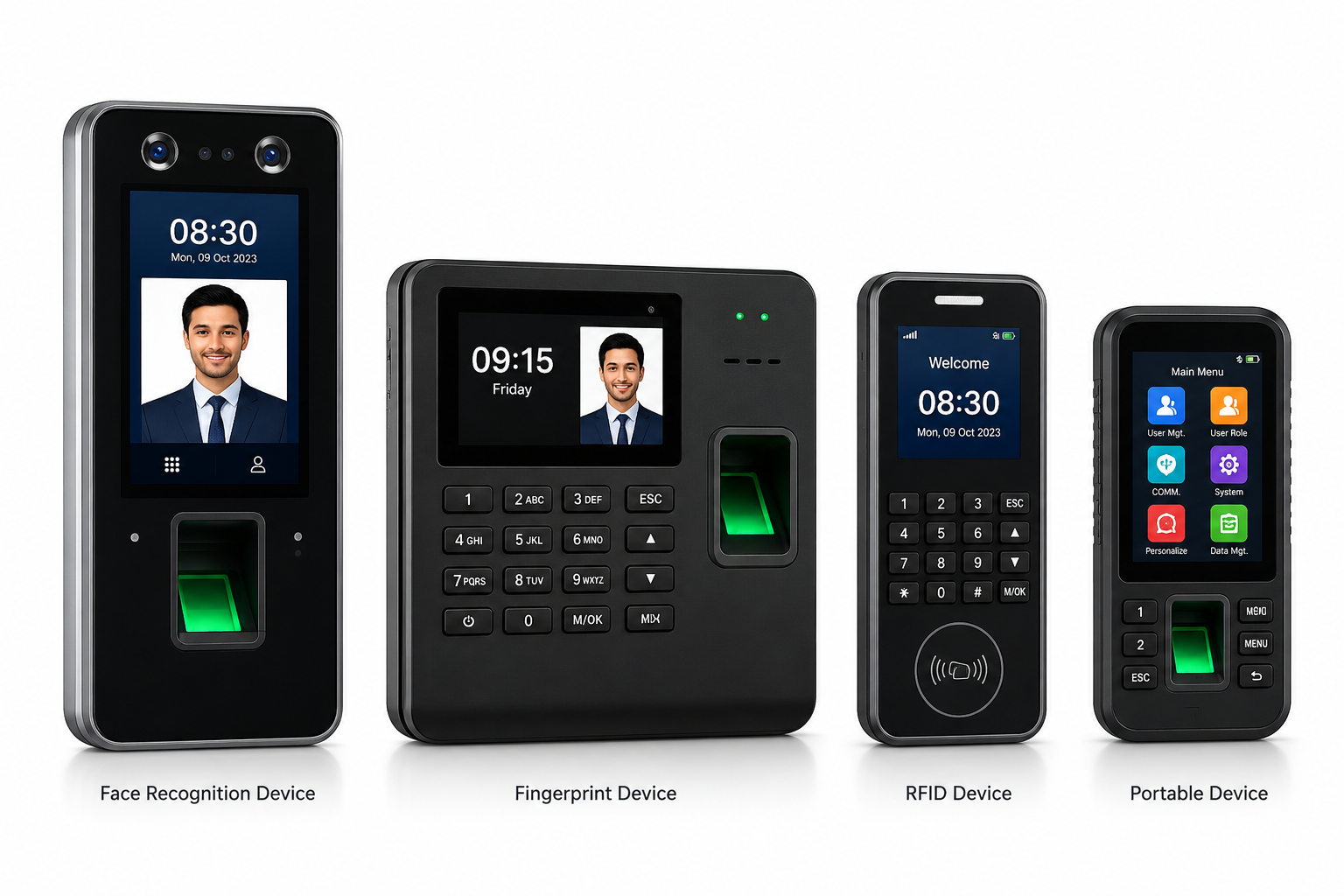
Not all biometric attendance technology works the same way. Here is how the main options compare:
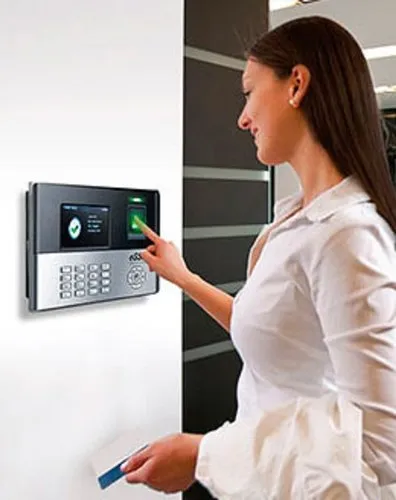
Fingerprint-based systems remain the most widely deployed option across Indian offices, retail stores, and small manufacturing units. They are cost-effective, highly accurate under normal conditions, and require no touchless infrastructure. The main limitation is reduced accuracy for employees with worn, damaged, or dirty fingerprints — common in manual labour and factory environments.
Face recognition systems have grown significantly since 2020, largely because they are contactless. A camera-based biometric attendance app or device matches an employee’s face against a stored profile in real time, without requiring any physical contact with the device. This makes it well-suited to high-traffic entry points and health-conscious workplaces.
Touchless attendance software is often used as an umbrella term covering both face recognition and other contactless methods such as QR-based or app-based check-in combined with liveness detection. For businesses prioritising hygiene, speed at entry points, or simply reducing wear on hardware, touchless options have become the preferred default rather than a premium add-on.
RFID and card-based hybrid systems combine a physical card with biometric verification as a second factor, often used in higher-security environments like factories or data centres where both access control and attendance need to be verified together.
Most businesses in 2026 are not choosing just one of these — they are choosing a biometric attendance management system that supports multiple methods under one platform, so different departments or locations can use whichever method fits their environment best.
What Makes a Biometric Attendance System "Best" for Your Business
“Best” is relative to your business type, and the wrong benchmark leads to over-buying or under-buying. Use these criteria to evaluate any vendor seriously:
- Matching accuracy — low false-rejection and false-acceptance rates, especially important once you cross 100+ employees, where accuracy issues compound quickly.
- Cloud connectivity — data should sync to a central dashboard automatically, not require manual export from each device.
- Multi-device and multi-branch support — the system should scale across locations without needing separate software for each branch.
- Software depth, not just hardware — the device only captures data; the software is what turns that into usable attendance rules, reports, and payroll input.
- Offline resilience — attendance should continue to be captured during internet outages, syncing automatically once restored.
- Payroll integration — the ability to convert verified attendance directly into salary calculation, without manual reconciliation.
- Support and onboarding — especially relevant for businesses without a dedicated IT team, where setup and troubleshooting support matters as much as the technology itself.
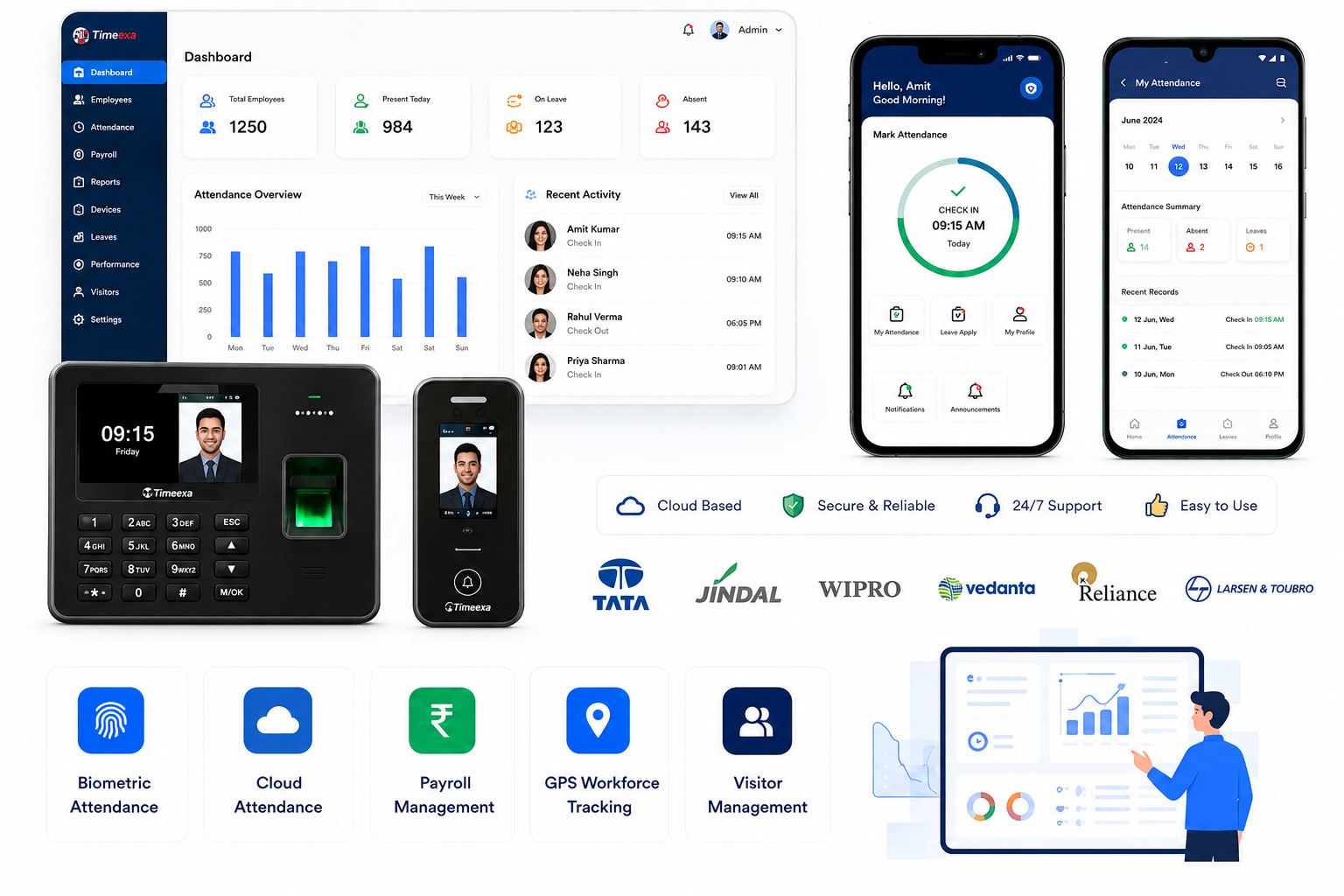
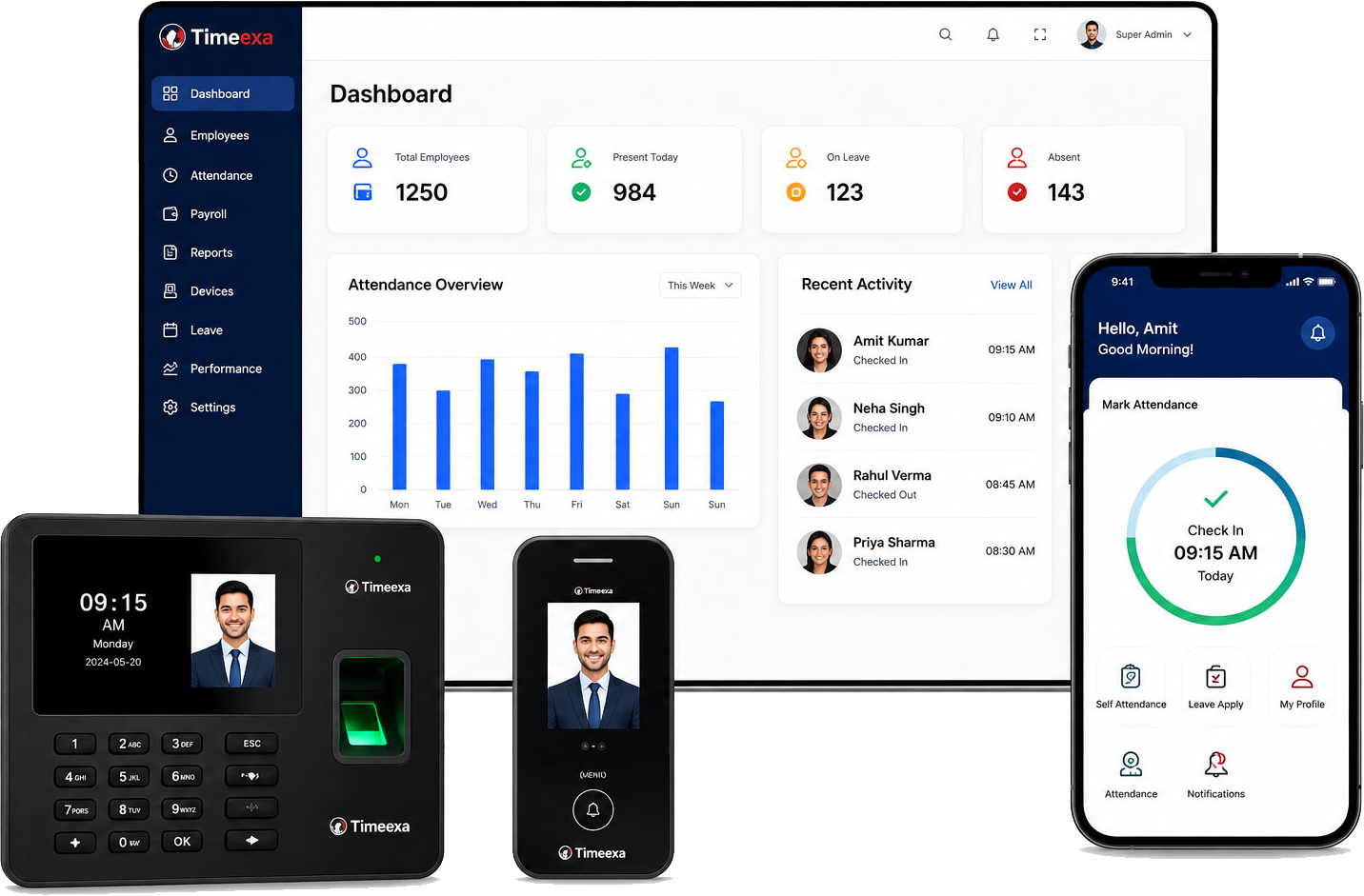
This is exactly the standard Timeexa’s biometric attendance system is built around — combining accurate hardware with a connected software layer, rather than shipping a device and leaving the rest to the business.
Common Mistakes Businesses Make When Choosing Biometric Attendance Software
Having worked with businesses across sectors, a few recurring mistakes stand out:
- Buying hardware without evaluating the software. A biometric machine alone only captures check-in data. Without proper software, that data stays locked at the device level, unusable for reporting or payroll.
- Ignoring scalability. A system that works for 20 employees can become unmanageable at 200 if it was never built for multi-branch or multi-device use.
- Underestimating payroll integration. Businesses often buy attendance and payroll as separate tools, then spend hours every month manually reconciling the two — defeating the purpose of automation.
- Overlooking offline reliability. In areas with inconsistent internet, a system that cannot capture attendance offline creates data gaps that are difficult to correct later.
- Choosing purely on device price. The cheapest biometric machine on the market often comes with the weakest software support, leading to higher costs in lost HR time down the line.
How Biometric Attendance Fits Into a Complete Workforce System
A biometric device is rarely the only tool a growing business needs. The most efficient setups connect biometric attendance with the rest of the workforce management stack:
- Businesses with multiple locations benefit from a cloud attendance software layer that consolidates biometric data from every branch into one dashboard.
- Teams with field, sales, or delivery staff who are rarely near a fixed biometric device need GPS workforce tracking to extend attendance capture beyond the office.
- Hybrid or remote employees benefit from a mobile attendance app that adds selfie and GPS-based check-in as an alternative to fixed biometric hardware.
- Once attendance is accurate, the real value is unlocked through a connected payroll management software, which converts verified biometric data directly into salary calculation, PF, and ESI compliance.
- Organisations managing guests or contractors alongside employees can add a visitor management system to the same platform for a complete on-site record.
Choosing a vendor that offers all of these under one connected system — rather than stitching together separate tools — is what actually determines whether “best” translates into real time and cost savings.
Pricing — What Should You Expect to Pay in 2026?
Biometric attendance software pricing in India typically depends on employee count, the number of devices or branches connected, and whether cloud hosting and payroll integration are bundled in.
Timeexa offers four transparent plans built around this:
- Starter Plan — Free (first year): Suited to small offices, clinics, retail shops, and startups with up to 50 employees. Includes unlimited biometric devices, employee and attendance management, a live attendance dashboard, basic reports, and cloud hosting. Renewal is ₹999 per year from the second year, complimentary in year one with a supported biometric device purchase.
- Business Plan — ₹499/month: For SMEs, schools, hospitals, and manufacturing units with up to 250 employees. Adds leave, holiday, and shift management, duty roster planning, device monitoring dashboard, and advanced attendance reports.
- Professional Plan — ₹999/month: For multi-location organisations and growing enterprises with up to 1,000 employees. Adds face enrollment management, RFID/card enrollment, bulk enrollment upload, device health dashboard, and branch-wise analytics.
- Enterprise Plan — ₹2,499/month: For large enterprises and factories with up to 5,000 employees. Adds API access, webhook and ERP/HRMS integration, single sign-on (SSO), custom reports, and a dedicated account manager with SLA-based support.
Every plan, including the free Starter tier, includes unlimited biometric devices — which means businesses of almost any size can deploy biometric attendance without worrying about per-device licensing costs, a rare structure in the Indian market where many vendors charge per device. Full details and current rates are available on Timeexa’s pricing page, and a free demo is available before you commit to a plan.
A Simple Checklist Before You Buy
Before finalising any biometric attendance vendor in 2026, run through this checklist:
- Does it support both fingerprint and face recognition, or just one?
- Does the software sync data in real time across all your branches?
- Is offline attendance capture included, or does it require constant internet?
- Does verified attendance flow directly into payroll, or will you still need manual reconciliation?
- Is pricing per-device, per-employee, or a flat plan — and does that structure match how your business will scale?
- Does the vendor offer onboarding support and a free trial or demo before you commit?
Final Thoughts
The “best” biometric attendance software in 2026 is not the one with the most advanced hardware — it is the one that connects accurate identity verification to a complete, scalable software layer covering reporting, multi-branch visibility, and payroll. Hardware alone captures data; the right software is what turns that data into time saved and payroll accuracy every single month.
Whether you are a small clinic setting up your first biometric device or an enterprise managing thousands of employees across multiple factories, Timeexa’s biometric attendance system is built to scale with you — connected to cloud attendance, mobile check-in, and payroll under one platform. Compare pricing plans and book a free demo to see which setup fits your business in 2026.
Our Products
Complete Workforce Management Solutions

Biometric Attendance System
Advanced biometric attendance solution supporting face recognition, fingerprint authentication, RFID cards, QR code attendance, and real-time cloud synchronization.
- Face Recognition Attendance
- Fingerprint Attendance
- RFID Card Support
- QR Code Attendance
- Real-Time Cloud Sync

Cloud Attendance Software
Manage employee attendance, shifts, leave, holidays, and reports securely from anywhere using our scalable cloud attendance platform.
- Multi-Company Management
- Multi-Branch Support
- Employee Self Service
- Attendance Dashboard
- Leave Management

Payroll Management Software
Automate payroll calculations, overtime management, salary processing, and payslip generation integrated directly with employee attendance data.
- Salary Automation
- Overtime Calculation
- PF & ESI Support
- Payslip Generation
- Payroll Reports

GPS Workforce Tracking
Track field employees, technicians, delivery staff, drivers, and remote teams using GPS-enabled attendance and real-time location monitoring.
- Live Location Tracking
- Geo-Fencing
- Route Monitoring
- Visit Tracking
- Mobile Attendance
Mobile Attendance App
Allow employees to mark attendance directly from mobile devices using selfie verification, GPS location tracking, and geo-fencing.
- Selfie Attendance
- Geo Attendance
- Mobile Attendance
- Leave Requests
- Attendance History

Visitor Management System
- Visitor Registration
- OTP Verification
- Visitor Pass Printing
- Employee Approval Workflow
- Reception Dashboard
Common Questions About Biometric Attendance Software
Q: What is the best type of biometric attendance system for a small office in India?
For a small, single-location office, a fingerprint or face recognition device connected to a cloud-based software layer is usually sufficient, giving accurate check-ins along with remote reporting access from day one.
Q: Is touchless attendance software more reliable than fingerprint scanning?
Both are highly reliable under normal conditions. Touchless, face-recognition-based systems tend to perform better at high-traffic entry points and require no physical contact, while fingerprint scanning remains a proven, cost-effective option for smaller, controlled environments.
Q: Can a biometric attendance management system work without internet access?
Well-built systems include offline capture, recording attendance locally on the device and syncing automatically to the cloud dashboard once connectivity is restored.
Q: How is biometric attendance data kept secure?
Reputable platforms store encrypted biometric templates rather than raw fingerprint images or facial photos, meaning the actual biometric data cannot be reverse-engineered even if a device is compromised.
Q: Does biometric attendance software integrate directly with payroll?
In a properly connected system, yes. Verified attendance data — including late marks, overtime, and leave adjustments — feeds directly into salary calculation without manual data transfer between attendance and payroll teams.